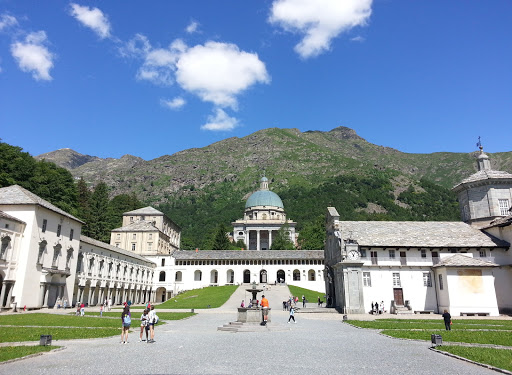
A jewel in the Alps: the old and new basilicas, the Museum of Treasures, and the frescoes tell a story of history and devotion. The mountain views are breathtaking, and the surrounding trails offer rejuvenating walks. Perfect for those seeking spirituality, nature, and art all in one place. Absolutely not to be missed!
Vyacheslav Snovidov
.
11 Novembre 2025
10,0
We went to the sanctuary in the evening, with the night lights and the tranquility of the late hour the place is even more suggestive.
Simone Ugliono
.
09 Novembre 2025
10,0
I'd been there as a child, then with my girlfriend, and now as a grandfather. So many years have passed, and it's heartbreaking to see such an imposing place of worship being abandoned, like a giant slowly falling asleep. I hope and pray that the Madonna venerated in this place will inspire and awaken the hearts of those who still make pilgrimages there. If you've never been, you must see it at least once; the second time, you'll be even more eager to return.
fabio franco
.
06 Novembre 2025
10,0
The entire complex is impressive in size, yet characterized by extreme simplicity. Located in beautiful surroundings, a visit to the sanctuary is highly recommended.
Mario De Luca
.
02 Novembre 2025
10,0
The Oropa sanctuary is a Marian place of worship located in Biella in the Oropa district, approximately 1,159 m above sea level, in a natural mountain amphitheater of the Biella Alps. According to tradition, the Oropa sanctuary was founded by Saint Eusebius, bishop of Vercelli, in the 4th century. Although this tradition has no documentary evidence, it is certain that Eusebius spread Christianity and Marian devotion in the Biella valleys. At that time, in fact, the population of the vast territory that roughly corresponds to modern-day Piedmont was still almost entirely pagan. In Vercelli, Roman polytheism prevailed, while in the Alpine valleys and in Monferrato, the cult of the ancient Celts was preserved intact, including the veneration of large erratic boulders. Eusebius's apostolic spirit shone through in his commitment to eliminating paganism, especially in ancient centers of worship such as Oropa and Crea, replacing the cult of Celtic female deities with the cult of the Mother of God, Mary. A Papal Bull issued by Pope Innocent III on May 2, 1207, mentions two churches in Oropa dedicated to Santa Maria and San Bartolomeo. According to the most recent historical studies, these buildings date back to at least the 8th-9th centuries. These are two small mountain buildings, but while the one dedicated to Santa Maria was incorporated into the expansion of the sanctuary, the one dedicated to San Bartolomeo was recently rediscovered and reopened for worship. The Gothic statue of the Black Madonna venerated in the sanctuary dates back to the first half of the 14th century. It was crafted from wood by the so-called Master of the Madonna of Oropa, an unknown sculptor and woodcarver from the Aosta Valley who was active between the late 13th and early 14th centuries. Numerous miracles and special graces are attributed to the Virgin.
Admission to the Basilicas and the nativity scene exhibition is free, but there are fees for the museum and guided tours. Admission to the Oropa Treasures Museum costs €4.00 (full price) and €3.00 (reduced price), while a complete guided tour (which includes the Sanctuary, the Museum, and the Royal Apartments) costs €8.00 per person.
Guido Gianinetto
.
31 Ottobre 2025
10,0
positive spiritual experience in a beautiful location
elio zanotto
.
30 Ottobre 2025
8,0
A charming place, the finish line of the Oropa walk. Everyone was very welcoming.
Edoardo Lorenzi
.
29 Ottobre 2025
10,0
A huge, magical place. Welcoming and well-organized.
Marco Cabella
.
28 Ottobre 2025
10,0
Silence and spirituality immersed in nature
Silvia Badriotto
.
28 Ottobre 2025
10,0
Visit on Saturday afternoon, beautiful place
Renato Decimo
.
26 Ottobre 2025
10,0








 Google
 TripAdvisor